Right or wrong, the president, in this case, knows of what he tweets. Go to any city council meeting when a developer attempts to rezone property for high-density zoning and angry neighbors appear in mass, organized and vocal, not an apron in sight.

All in Economics
Right or wrong, the president, in this case, knows of what he tweets. Go to any city council meeting when a developer attempts to rezone property for high-density zoning and angry neighbors appear in mass, organized and vocal, not an apron in sight.
Ah yes, another new normal. “Speculation in the capitalist system performs a function which must be performed in any economic system however organized: it provides for the adjustment of supply and demand over time and space,” wrote Ludwig von Mises in his book “Socialism.”
One of my economics professors once told the class, “Freedom is a liability for those who can’t govern themselves,” which means this argument will be thrust into the courts. The rights infringement argument is heading towards, first, statute law, and second, possibly, into a common law brick wall.
So while Trump’s true believers require no convincing as to the President’s assertion that Covid-19 will magically go away, his administration is taking control of the information. “The Trump administration ordered hospitals to bypass the Centers for Disease Control and Prevention and send all COVID-19 patient information to a central database in Washington,” reports USA Today.
In other words, forget the mask, stay home. Isolation is the only solution. But, after a couple of months of being cooped up at home, many Americans can’t handle it. One wonders why? The answer lies in Hans-Hermann Hoppe’s groundbreaking “Democracy The God That Failed.”
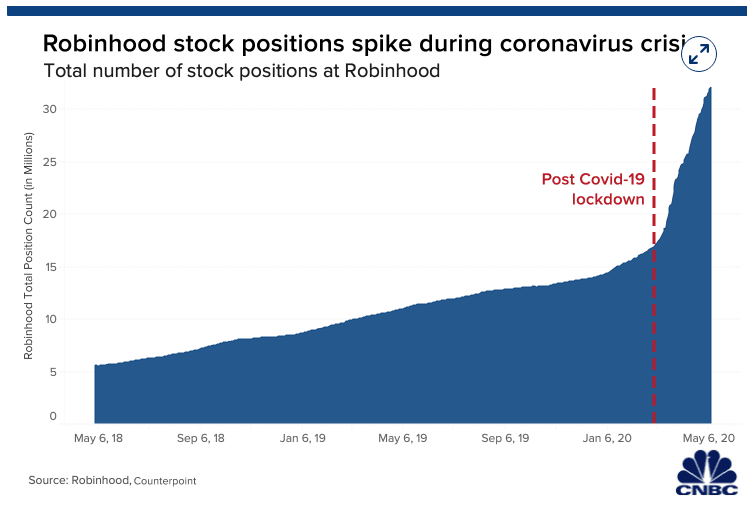
Who knew a person can now buy partial shares of Amazon, Tesla, and other modern unicorns. If nothing else, Wall Street thinks outside the box. If you thought Robin Hood wore a pointy hat adorned with a feather, stealing from the rich to give to the poor, turn your calendar. The new Robin Hood allows the rich to steal from the poor.
If one were looking for clues as to why the stock market has rebounded while daily economic news grows worse, besides the Federal Reserve’s Jerome Powell “flooding of the market” with liquidity, another reason could be the flood of new punters betting on stocks, from high-flying tech shares to dead-in-the-water leisure stocks.
Eglet’s filing claims, “Shortly after November 17, 2019, the PRC (People’s Republic of China) and the other Defendants knew, or should have known, that COVID-19 was a ‘new’ dangerous, contagious, and deadly virus because many Chinese citizens who contracted the virus were getting very sick, and some were dying. Moreover, DNA samples taken from these very sick and dying people confirmed that this was a ‘new’ virus for which there was no vaccine or cure.”
Toilet paper may be in short supply, but the Federal Reserve is determined to make sure dollars are not.
“We’re out of money,” a call to the Detroit home office revealed. “Everyone wants to refi and we don’t have the funds.” Always the salesman, the Quicken rep said, ``I don’t know why anyone is waiting, rates will never go below 3 percent,” inspiring a hearty laugh from this writer.
Pal does not blame the president. He’s in the finance and investments business. For him, this is all about coming out on the other side, healthy and financially solvent. He has no political axe to grind.
Product margins are skinny and technology has taken away the asymmetric knowledge advantage dealerships once had. So, once a customer falls in love with their new pride and joy, the hapless customer is sent to The Box.
All this weakness has something to do with coronavirus, in the eyes of socionomists. In the March issue of The Socionomist, with the cover devoted to the virus, Matt Lambert and Mark Galasiewski quote Robert Prechter, “disease sometimes plays a prominent role in major corrective periods.”
A few folks are aware of the repo tantrum which occurred last September. Overnite rates for money secured by US debt popped to ten percent, signaling at least a financial plumbing problem or a collateral crisis, due to the financial mandarins trying to sneak away from the party with $100 billion that was in the Fed’s bottomless punch bowl.
So where the state has failed, private enterprise has stepped into the breach. Profits will make that happen. High cost makes customers more careful with how much they use. Nobody is wasting water in Kathmandu. “Before, I didn’t think about how often I could shower or when I can clean the house,” said Laxmi Magar, a housewife and mother of six. “But now that water is so expensive I watch every drop.”
And while CO2 concentrations have increased, causing Ms. Thornberg to lose sleep, “one cannot help but notice that a large part of the warming trend over the last 120 years took place prior to 1950, a period where CO2 concentrations in the earth’s atmosphere remained relatively low,” wrote the natural resource investing pair.
China’s banks hold $30 trillion in deposits according to Alexander Campbell, more or less double the amount of aggregated U.S. bank deposits. Campbell was pitching Alex Rosenberg on Real Vision on his thesis of buying gold in Yuan terms with the idea that bank bailouts take a flood of central bank created fiat money to paper over. So while the Chinese may want to keep the Yuan near the 7 to the dollar range, bank busts are just beginning in China and 7 may become a distant memory.
Roughly $1 trillion in BBB debt is in just five companies plus the shale industry. The five are household names: AT&T, Ford, General Motors, General Electric, and Dell.
Jerome Powell’s January hawk-to-dove pivot is now understandable. He can’t afford for the bonds of Blue Chip names to tip into junk land where buyers will be few and far between.
A year ago, it was tighten, tighten, tighten, now three rate cuts are expected by the market by year-end. Gromen told Harrison that Trump’s tariffs matter some, but, it’s the deficits that really matter and are forcing the Fed’s hand.
The U.S. and EU banks are enormously intertwined, particularly in terms of funding and derivatives. Corporate debt has exploded and the bond market is only liquid in one direction. Zero interest rates have pushed pension plans to the brink of insolvency, even with a bull market.