Since Ailes’s passing in 2017, Fox has still been Trump TV, but lately, the network hasn’t been Trump enough for the President, who recently tweeted “We have to start looking for a new News Outlet. Fox isn’t working for us anymore!”

Since Ailes’s passing in 2017, Fox has still been Trump TV, but lately, the network hasn’t been Trump enough for the President, who recently tweeted “We have to start looking for a new News Outlet. Fox isn’t working for us anymore!”
China’s banks hold $30 trillion in deposits according to Alexander Campbell, more or less double the amount of aggregated U.S. bank deposits. Campbell was pitching Alex Rosenberg on Real Vision on his thesis of buying gold in Yuan terms with the idea that bank bailouts take a flood of central bank created fiat money to paper over. So while the Chinese may want to keep the Yuan near the 7 to the dollar range, bank busts are just beginning in China and 7 may become a distant memory.
Her account, “Washington Siren: A Woman’s journey through scathing scandals, lies, and secrets inside the FDIC, HUD, IRS and other agencies, with a love story that survives it all.” written, for some reason in the 3rd person, chronicles O’Toole’s long career of Sisyphean frustration with government bureaucracy.
Roughly $1 trillion in BBB debt is in just five companies plus the shale industry. The five are household names: AT&T, Ford, General Motors, General Electric, and Dell.
Jerome Powell’s January hawk-to-dove pivot is now understandable. He can’t afford for the bonds of Blue Chip names to tip into junk land where buyers will be few and far between.
After IndyMac, Bovenzi points out over 400 banks would fail over the next four years. Why is it when one bank fails, despite FDIC insurance and other government interference, numerous other institutions often go bust?
The Sharps, dedicated to making money, show up and bet against the line when it appears fresh and ripe for the picking. The Squares bet the picked over and massaged point spreads and odds with their hearts on their sleeves.
Parking shiny coins in a safe deposit box may not provide the excitement that FAANG investors are used to. For those with a strong stomach speculating in junior mining shares provides maximum leverage to gold’s price--up and down. For the past decade, it’s been mostly down and painful.
Ludwig von Mises explained, “Society is division and association of labor. In the final analysis, there is no conflict of interest between society and the individual, as everyone can pursue his interest more efficiently in society than in isolation.
A year ago, it was tighten, tighten, tighten, now three rate cuts are expected by the market by year-end. Gromen told Harrison that Trump’s tariffs matter some, but, it’s the deficits that really matter and are forcing the Fed’s hand.
Boom times cause lenders to first make more and more speculative financing, and then graduate to Ponzi finance before it all comes crashing down. The author quotes Minsky. “Over a protracted period of good times, capitalist economies tend to move from a financial structure dominated by hedge finance units to a structure in which there is a large weight of units engaged in speculative and Ponzi finance.”
The U.S. and EU banks are enormously intertwined, particularly in terms of funding and derivatives. Corporate debt has exploded and the bond market is only liquid in one direction. Zero interest rates have pushed pension plans to the brink of insolvency, even with a bull market.
Elvira’s gold buying makes me think she has read Saifedean Ammous’s “The Bitcoin Standard: The Decentralized Alternative to Central Banking.” Don’t let the title fool you. This book is not the cover-to-cover crypto cheerleading/gold bashing other authors attempt to jam down our throats. Dr. Ammous Is actually a Professor of Economics, and none other than “Black Swan” author Nassim Taleb wrote the introduction.
Most believe it’s clear sailing for housing. Jurow’s view its anything but rosy for housing. He believes the housing rebound is a mirage orchestrated by lenders and mortgage servicers keeping foreclosed homes and subprime loans in serious default off the market. In other words, there are millions of homes just waiting to hit the market. Sometime.
When they begin saying they are going to work on their balance sheets, that’s code for paying down debt and will be the end of share buybacks. As DiMartino Booth puts it, companies will then be taking care of bond holders rather than shareholders. The implication is the liquidity driving the bull market will seize up and a market correction is on the way.
Banks bitten in 2008, are, along with their regulators, twice shy to make the marginal loan. The short summary of Hanke’s remarks in the latest Grant’s Interest Rate Observer, includes, “But he invited the audience to imagine an upsurge in bank lending, perhaps stimulated by a Federal Reserve decision to pay a reduced rate of interest on excess reserves.”
“Fragile By Design” is a big book, and while it looks at banking systems in other countries, the authors devote many pages to the 2008 crash in the U.S. But first, they make the important point that bank failure losses used to be borne by bank owners and depositors. Of course, now, with government overseeing the operation, costs have been shifted to taxpayers, in what the authors call “The Game of Bank Bargains.”
The mall was encumbered by a $200 million commercial real estate mortgage, well supported by the 2007 value for the property of $250 million. However, by 2017, SPG defaulted because it was “unable to repay the loan at maturity due to the size of the loan compared to the net operating income that the property generates and the tenants inability to increase sales due to the economic challenges.”
Quart’s Sunday Times piece is entitled “The Con of the Side Hustle.” People taking on multiple jobs refer to them as “side hustles.” Which is kind of cute. Uber is recruiting online, not with the tagline “do you have to have a second job to pay your bills” but rather something cool, like, “Get your side hustle on.”
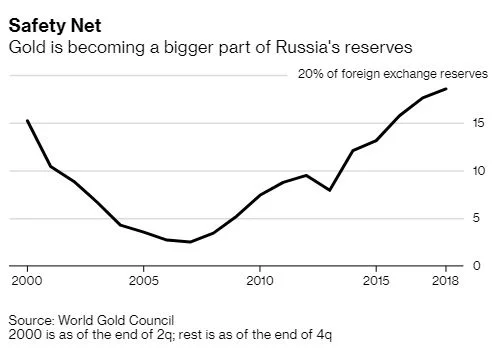
Russia is not alone in lightening up on dollar exposure. In the 4th quarter of last year, “reserve managers actively decreased their allocation to USD—the share of USD reserves declined despite modest Dollar appreciation—while they actively added to EUR and CNY reserves. According to Goldman calculations, the drop in Q4 USD reserves was equivalent to just over $50 billion in dollar reserves sold,” reports ZeroHedge.com.
The folks at GNS Economics, in their “Q-Review 1/2019” report, contend, contrary to the president, “the global economic recovery since 2009 has not been real. It has been achieved with massive debt and monetary stimulus, which has created an economy where normal rules of the market economy do not apply.”